
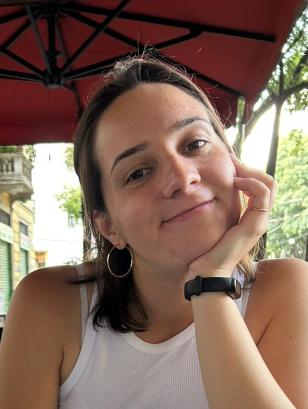
CLIC nodigt jullie graag uit voor de eerstvolgende WOLEC-sessie die plaatsvindt op dinsdag 3 maart van 12:00 tot ten laatste 13:30 in C3.06 (Vergaderzaal PE). Spreker Chiara Cremona (VUB) zal een lezing geven met als titel: "Through French Mediation: Foreign Literature in the Early 19th-Century Italian Periodical Press".
Chiara Cremona behaalde een bachelordiploma in Moderne Talen en Literaturen (met een specialisatie in Engels en Spaans) aan de Universiteit van Milaan, en een Erasmus Mundus-master Crossways in Cultural Narratives, gevolgd aan de Universiteit van Santiago de Compostela, de Universiteit van Guelph en de NOVA-universiteit van Lissabon. Tijdens haar studies in Canada werkte ze als onderwijsassistent voor cursussen Italiaans en als onderzoeksassistent voor het project “Transcultural Journalism: English Novels and the Italian Press (1720–1830)”, opgezet door professor Sandra Parmegiani. Dit Digital Humanities-project heeft tot doel de receptie van achttiende-eeuwse Engelse romans in Italië te onderzoeken door recensies te verzamelen die in Italiaanse tijdschriften uit die periode werden gepubliceerd. Momenteel is ze doctoraatsstudente aan de VUB, waar ze werkt aan het project “Rebuilding Post-Revolutionary Identities in England, France and Italy: The Reception, Discussion and Stigmatization of Unruliness in Novels through the Periodical Press (1816–1831)”, gefinancierd door het FWO en begeleid door professor Dirk Vanden Berghe.
De voertaal is het Engels. Een broodjeslunch wordt voorzien. We vragen u om uw aanwezigheid ten laatste tegen 27 februari via deze link te bevestigen. Voor meer informatie over WOLEC, klik hier.
Tot dan!
*****
CLIC is excited to invite you to the next WOLEC session, taking place on Tuesday 3 March from 12:00 till 13:30 in room C3.06. Chiara Cremona (VUB) will give a lecture titled: "Through French Mediation: Foreign Literature in the Early 19th-Century Italian Periodical Press".
Chiara Cremona holds a Bachelor’s degree in Modern Languages and Literatures (with a specialisation in English and Spanish) from the University of Milan, and an Erasmus Mundus Master Crossways in Cultural Narratives, carried out in the University of Santiago de Compostela, the University of Guelph and the NOVA University of Lisbon. During her studies in Canada, she worked as a Teaching Assistant for Italian language courses, and as a Research Assistant for the project “Transcultural Journalism: English Novels and the Italian Press (1720-1830)”, created by professor Sandra Parmegiani. This Digital Humanities project aims at investigating the reception of 18th-century English novels in Italy by collecting the reviews published on Italian periodicals of the time. She is currently a PhD candidate at VUB, working on the project “Rebuilding post-revolutionary identities in England, France and Italy: the reception, discussion and stigmatization of unruliness in novels through the periodical press (1816-1831)”, funded by FWO and supervised by professor Dirk Vanden Berghe.
The lecture will be held in English. A sandwich lunch will be provided. We ask you to confirm your presence via this link by 27 February. For more information about WOLEC, click here.
We hope to see you there!
Abstract
The circulation of foreign literature in early nineteenth-century Europe was the result of a network of transnational and transcultural exchanges. In the case of Italian periodicals, a range of strategies was implemented to incorporate European literary culture into the national press, such as drawing systematically on French journals as primary intermediaries, and publishing specialised anthology periodicals conceived from the outset as vehicles for translated content. Rather than accessing foreign literatures at their source, Italian editors and journalists operated with layers of stratified interpretation, and this mediation inevitably shaped what Italian readers could read, and how they were directed to interpret it.
In this talk, I trace two interconnected dimensions of this phenomenon. The first concerns the structural dependence of journals such as the Biblioteca italiana and the Indicatore Lombardo on French publications like the Revue britannique and the Revue de Paris: not only were articles translated from these French periodicals, but French translations of foreign literary works served as the basis for the Italian version, with the result that critical frameworks applied to authors and texts were often imported alongside the texts themselves. The second refers to anthology periodicals such as the Antologia straniera, whose editorial prefaces reveal the principles guiding the selection and arrangement of translated material, and thus allow us to reconstruct the motives that determined which books, authors, and ideas reached Italian audiences. Read together, these two mediation approaches show that Italian periodicals in the post-Napoleonic era were not passive conduits for a pre-existing European literary culture, but active agents who constructed that culture in the very act of mediating it.