
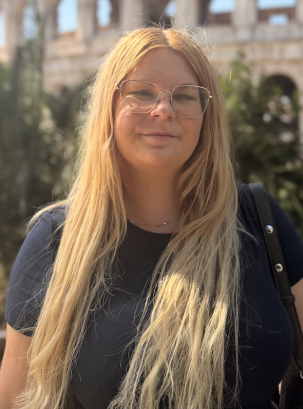
CLIC nodigt jullie graag uit voor de eerstvolgende WOLEC-sessie die plaatsvindt op dinsdag 27 oktober van 12:00 tot ten laatste 13:30 in 5C03. Spreker Katarína Rendošová (Pavol Jozef Šafárik-universiteit & Universiteit van de Balearen) zal een lezing geven met als titel: "The Post-Black Bildungsroman in Twenty-First-Century Fiction: Three Novels, Many Selves".
Katarína Rendošová is doctoraatsonderzoeker in Britse en Amerikaanse studies met een dubbel doctoraatstraject aan de Pavol Jozef Šafárik-universiteit in Košice, Slowakije, en de Universiteit van de Balearen in Palma de Mallorca, Spanje. Haar onderzoek richt zich op hedendaagse Black British literature and Black women’s literature. In haar bachelorproef onderzocht ze het werk van Zadie Smith, met specifieke aandacht voor de representatie van Londen. Haar masterproef, die ze eveneens voltooide in het kader van een dubbelgraadprogramma met de UIB, onderzocht de representatie van de stad in de romans van Andrea Levy en Louise Hare binnen de context van Black British-literatuur. Haar huidige doctoraatsonderzoek richt zich op de post-Black Bildungsroman in eenentwintigste-eeuwse fictie, waarbij ze vraagstukken rond identiteitsvorming, persoonlijke ontwikkeling en verbondenheid onderzoekt in hedendaagse Black women's writing.
De voertaal is het Engels. Een broodjeslunch wordt voorzien. We vragen u om uw aanwezigheid ten laatste tegen 22 oktober via deze link te bevestigen. Voor meer informatie over WOLEC, klik hier.
Tot dan!
*****
CLIC is excited to invite you to the next WOLEC session, taking place on Tuesday 27 October from 12:00 till 13:30 in room 5C03. Katarína Rendošová (Pavol Jozef Šafárik University & University of the Balearic Islands) will give a lecture titled: "The Post-Black Bildungsroman in Twenty-First-Century Fiction: Three Novels, Many Selves".
Katarína Rendošová is a PhD candidate in British and American Studies at Pavol Jozef Šafárik University in Košice, Slovakia, and the University of the Balearic Islands in Palma de Mallorca, Spain, where she is pursuing a double doctoral degree. Her academic research has consistently focused on contemporary Black British and Black women’s literature. In her BA thesis, she explored Zadie Smith's novel with special focus on the representation of London. Her MA thesis, completed also as part of a double-degree programme with UIB, examined the representation of the city in the novels of Andrea Levy and Louise Hare within the context of Black British literature. Her current doctoral research focuses on the post-Black Bildungsroman in twenty-first-century fiction, investigating questions of identity formation, development, and belonging in contemporary Black women’s writing.
The lecture will be held in English. A sandwich lunch will be provided. We ask you to confirm your presence via this link by 22 October. For more information about WOLEC, click here.
We hope to see you there!
Abstract
Coming of age sounds simple. It becomes considerably less so when there is no single self to come of age into. The Bildungsroman has traditionally been understood as a narrative of development: a young individual encounters the world, undergoes formative experiences, develops a sense of self, and negotiates a place within society. Yet what happens to this model when questions of race, gender, migration, history, and belonging complicate the very idea of a coherent self and a predictable path towards maturity? My doctoral research explores these tensions through the concept of the post-Black Bildungsroman, examining how contemporary Black women’s writing transforms one of Western literature’s most enduring narratives of development.
Drawing on Marlon Lieber’s concept of the post-Black Bildungsroman, as well as scholarship on the traditional, feminist, postcolonial, and postmodern Bildungsroman, my dissertation examines how contemporary Black female protagonists negotiate processes of development, identity formation, and belonging in relation to the social structures that shape their lives. The analysis focuses on three novels: Yaa Gyasi’s Homegoing (2016), Bernardine Evaristo’s Girl, Woman, Other (2019), and Chimamanda Ngozi Adichie’s Dream Count (2025). Through a comparative reading of these works, I consider both the continuities they maintain with the traditional Bildungsroman and the ways in which they depart from or transform its established conventions. Particular attention is paid to features that remain central to the genre, including formation through formative experience, individual development in relation to society, the development of self-understanding, the negotiation between individual aspirations and social expectations, and the presence of a developmental trajectory. At the same time, the dissertation investigates how these features are complicated by questions of race, gender, class, migration, cultural belonging, and historical memory. Rather than treating the twenty-first-century Bildungsroman as a complete departure from its nineteenth-century origins, I examine the genre as a form in continuous transformation, in which established structures are retained, revised, or challenged.
The dissertation argues that the post-Black Bildungsroman emerges not simply through the addition of Black characters to an established genre, but through a fundamental reconsideration of what development, identity, and belonging can mean within contemporary Black women’s narratives. By bringing together the genre’s historical conventions and its more recent feminist, postcolonial, and postmodern transformations, the research seeks to demonstrate how the post-Black Bildungsroman both inherits and unsettles the developmental model at the heart of the genre.