

Gender Anxieties, the Study of Literature and the Institutional Landscape
CLIC members Maxime Honinx, Eva Ulrike Pirker, Marcela Scibiorska, Jade Thomas and Hannah Van Hove teamed up to organise this year’s 2025 VAL Symposium. And although it was the conference of the Flemish Association for Comparative Literary Studies (Vlaamse Vereniging voor Algemene en Vergelijkende Literatuurwetenschap), the participants were international. 20 engaging papers on historical and recent topics, some more literary in orientation, others with a focus on culture, film and language, were delivered in 10 panels. The turnout at Hoek38 in the centre of Brussels was significant, as the conference theme hit a nerve:
The political and institutional landscape is characterised by an increasing contentiousness surrounding gender debates. In their depictions, discourses surrounding gender appear as an ideological threat to a perceived ‘natural’ and morally righteous order of heteronormative family structures and homogenous, binary identity categories. The recent rise of mainstream visibility of non-binary and trans individuals’ narratives has prompted a productive rethinking of previous approaches to feminist and queer literary studies, yet it has also provided an opportunity for supremacist ideologies to exploit these developments for political gain.
The symposium raised the question of how the academic study of literature and other forms of artistic expression responds to prevailing gender anxieties. It provided an opportunity to consider the role of literary and cultural studies in these debates from both a historical and a contemporary perspective, including decolonial and intersectional approaches to gender. Discussions spiralled around the impact of recent developments on the study of women's writing, on queer, trans and masculinity studies and on literary practice more generally.
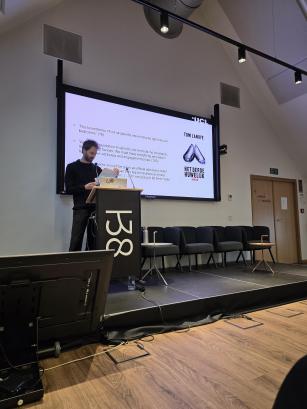
The symposium was framed by two keynotes. Hans Demeyer (Dutch & Comparative Literature, UC London and CLIC Scientific Advisory Board member) addressed gender anxieties and whiteness in Flemish literature, whereas Teagan Bradway (English, SUNY Cortland/Society for the Humanities Fellow at Cornell University), explored practices of attachment in Queer Kinship Narratives. The podium discussion with panelists Alison E. Woodward (Political Sociology, VUB), David Paternotte (Sociology and Gender Studies, ULB) and Andrea Pető (History and Gender Studies, CEU Vienna), chaired by Gily Coene (Director of the VUB Research Centre for Gender, Diversity and Intersectionality) provided timely insights into the current state of the institutional landscape and into the ways in which the threat to gender studies is indicative of, if not synonymous with, threats to academic freedom and critical thinking.
What advice to give a PhD student in times of reactionary backlash and economic cuts? Can the humanities and literary studies provide a hospitable environment for all students and staff members? What are the challenges when confronting the kinds of violence that are deeply ingrained in culture, mindsets, traditions and language? The insight that these issues can quickly become overwhelming led the organisers to consult a safe space facilitator, Stacey Oh, who was involved in the preparations of, and present throughout the day. Her feedback, and the feedback received from participants, will be incorporated in the preparation of the next steps.
What’s next?
Jade Thomas and Maxime Honinx will coedit a special issue of the Cahier voor Literatuurwetenschap (CLW) devoted to the conference topic. Other activities related to the topic will be announced on the CLIC website, social media and Newsletter. The next VAL conference will be hosted by Ghent University.