Despite the proliferation of scholarship on Orientalism since Edward Said, the representation of Persia in Western culture has been studied almost exclusively through poetry, fiction, and travel writing. Simultaneously, Victorian periodical studies have focused on formal colonies (India, Egypt and elsewhere in Africa) leaving unexamined how the illustrated press negotiated a space that was neither fully sovereign nor formally colonised. This project aims to address this gap for the first time by asking: how does the illustrated periodical press participate in the construction of a paracolonial space, i.e., a space that is neither fully annexed nor genuinely sovereign? Furthermore, how does the ILN use the specific affordances of the illustrated press to respond to events related to Persia? What does this representation reveal about the underlying ideologies of the periodical, and Britain’s position vis-à-vis Persia during the second half of the 19th century? This project examines the Illustrated London News' coverage of Persia across two moments of intensified Anglo-Persian encounter: the Anglo-Persian War of 1856–57 and Nasir al-Din Shah's first visit to England in 1873.
Situated at the intersection of Victorian periodical studies and imperial visual culture, this project mobilises the concept of paracoloniality, as suggested by Bayly, to theorise Persia's ambiguous position as a state that was neither colonised nor equal, but operating under sustained British and Russian pressure. Reading the ILN not as a neutral record of events but as a discourse in dialogue with other discourses of Victorian society, it traces how the journal’s affordances, its seriality, materiality, and verbal-visual form, organised Persia as an object of imperial concern for metropolitan readers. The project’s first sustained output, a close reading of the Shah's 1873 visit across five consecutive issues, argues that the ILN structured the encounter as an asymmetrical spectatorial event: an exhibition of an Anglo-Persian encounter.
We have now to deal with the most elaborate acts and scenes in this grand pageant of British wealth and power, which is certainly more significant as an exhibition of what England herself is, what she possesses, and what she can do, than important as a mere complimentary demonstration to the Shah—no very great personage, after all, either in Europe or in Asia, compared with some other potentates we have seen coming and going in London.
“The Shah of Persia.” The Illustrated London News, July 5, 1873. British Newspaper Archive.
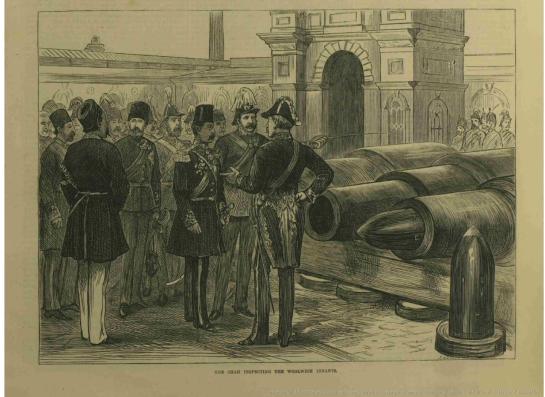
“The Shah Inspecting the Woolwich Infants,” Illustrated London News, 28 June, 1873. British Newspaper Archive.
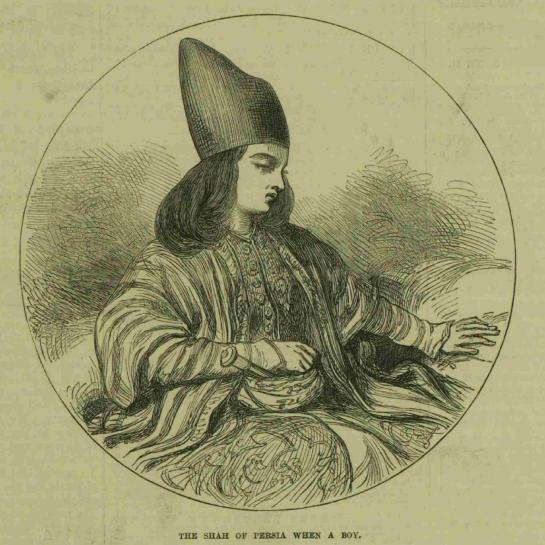
* Main photo (top left): "The Shah of Persia When a Boy," Illustrated London News, June 14, 1873. British Newspaper Archive.
Researcher: Mehran Ghandi