

On December 5, 2025, the Centre for Literary & Intermedial Crossings (CLIC) held its 15th Annual Research Day on the theme “Journalism and “Literature.”
The day’s topic attracted an ensemble of scholars coming from 8 universities in 6 different countries, who shared their insights into the multiple intersections between the two fields, stimulating the audience’s interest and sparking exciting discussions in the room.
The keynote lecture by John S. Bak (Université de Lorraine) set the tone for the day, by probing deep into the landscape of the French press and the representation of the Boers during the Anglo-Boer War, 1899–1902. Bak observed the counter-narrative function of the work of H. Rider Haggard and Jean Carrère, emphasizing the entanglements between literary journalism and imperialist fiction in the South African context.
The 10 presentations that followed were arranged in three panels, each illuminating an important angle of the theme and collectively working to demonstrate the manifold — and often overlooked — intersections between literature and journalism, in theory and practice.
The first panel focused on the transformative impact of literary journalism as a site of resistance, memory, and progress. The contributions examined the hybrid journalism of a Caribbean oppositional journal of the 1930s, where social realism served as a tool of political exposure; the transnational orientation of Sub-Saharan African cultural and political magazines from the interwar period to the 1960s as engines of decolonization and literary canon-formation; and the practice of mnemonic journalism in a reportage on a sacred African landscape, where relational and self-reflexive writing displaces the distanced voice of conventional ethnographic reporting.
The second panel explored literary journalism and serialization across print and digital formats. The contributions examined the serialization of short fiction in post-unification Italy as a key site for rethinking literary value; the role of long-running children's periodicals in shaping literary taste across generations; the Arbëresh diaspora press as a vehicle for national consciousness and cultural survival, in which literature functioned not as aesthetic supplement but as political instrument; and the reactivation of the feuilleton tradition in a contemporary serialized email newsletter covering a high-profile criminal trial, where format, delivery, and media ecology prove as central to literary journalism as style and authorship.
The third panel addressed the creative reception of literature through cultural journalism, literary criticism, and advertising in periodicals. The contributions mapped the features and functions of literary reviews in the English, French and Italian press of the early nineteenth century; explored eighteenth-century Italian periodicals as a uniquely fluid discursive space for women to negotiate literary authority; and examined how a French-language magazine shaped the reception of translated fiction in mid-century Egypt, illuminating the interplay between journalistic discourse, advertising strategy, and literary mediation in a multilingual postcolonial context.
Taken together, the day's presentations illuminate a rich and varied landscape of encounters between two fields whose boundaries have never been as fixed as canonical accounts might suggest. Whether engaging with questions of narrative form and authorial voice, the politics of representation and cultural gatekeeping, the economics of publishing and translation, or the ideological underpinnings of editorial choices, the contributions converge on a shared insight: that the space between literature and journalism has always been a productive and contested one, shaped by struggles over truth, legitimacy, and cultural power.
The program's breadth is equally striking in its temporal and geographical range. The historical arc stretches from the Enlightenment periodicals of eighteenth-century Italy through the anti-colonial press of the mid-twentieth century to the digital media environment of the present day. The geographical reach extends across Europe, North and Sub-Saharan Africa, the Caribbean, and the Arab world — a scope that resists any narrowly Eurocentric framing and speaks to growing calls within the field for more genuinely comparative, cross-cultural approaches to the study of journalism and literature.
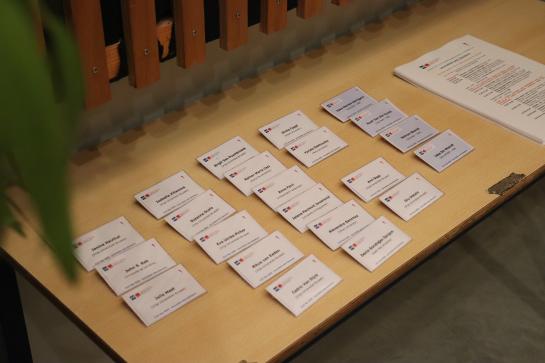
The event took place at VUB Etterbeek campus and was concluded with a fine dinner at a local restaurant.
The organizers would like to thank the Doctoral School for Human Sciences and CLIC for their funding support, and CLIC members Birgit Van Puymbroeck and Isabella Villanova for their assistance in panel chairing.
What’s next?
The organizers Chiara Cremona, Thomas Mantzaris, Jelle Mast, and Marcela Scibiorska will be co-editing a special issue of the Journal for Literary and Intermedial Crossings (JLIC) devoted to Journalism and Literature. Following an open call, the process is already underway, and the issue is scheduled for release in the second half of 2027.