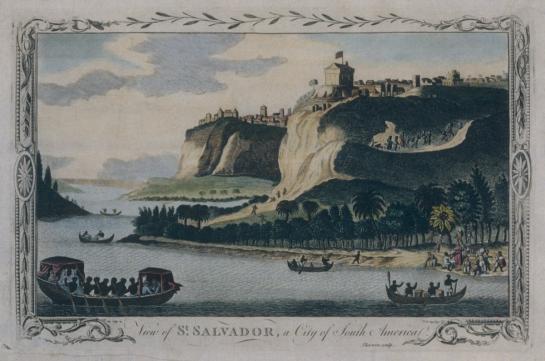
View of St. Salvador, a City of South America, John Keyse Sherwin (1751–1790).
How has Anglophone literature shaped the global image of Brazil? How do historical ‘English lenses’ continue to filter contemporary perceptions of the country? In what ways do contemporary Anglophone authors subvert these colonial tropes? Since 1526, Brazil’s image has been shaped by a dominant Anglophone gaze, despite the absence of direct colonisation. British cultural agents helped produce a ‘semi-mythical construct’ which I term ‘Brazilianism’. Like Edward Saïd’s Orientalism, it produces knowledge that assigns an often-inferior nature to Brazil and its people. Over time, these tropes have been reframed through neoliberal meritocratic values, presenting inequality not as a colonial legacy but as the result of supposedly ‘unmotivated’ or ‘incapable’ Brazilians. LITBRAZ – Through English Lenses: The Invention of Brazil in the Global Literary Imagination aims to map this representational regime across four historical stages: from foundational travel narratives of buccaneers to its contemporary ‘refabulations’. By examining how the images of this collateral colonial archive circulate–and the legal and economic arrangements that produced them–LITBRAZ explores the role of Anglophone literature in shaping global stereotypes and racial hierarchies. In so doing, it reveals how identity and ‘Brazilian nature’ are negotiated within a hegemonic system of knowledge that persists even when it claims to be transformed. The project, currently in its developmental phase under the supervision of Prof. Eva Ulrike Pirker, is supported by the Brazilian National Council for Scientific and Technological Development - CNPq (Grant No. 201292/2026-2) and runs from 5 January 2026 to 30 June 2027.
Researcher: Tiago Silva